Showing posts with label hiking. Show all posts

Sunday, May 25, 2008

The tale of two W's

A hike in the morning and beer samples in the afternoon make for a great day out. The fact that both can be found not more than five miles apart around Westminster, MA, and have a strong connection to each other makes it even more interesting.
Mass Audubon Wachusett Meadows Wildlife Sanctuary offers numerous trails, old stonewalls, beaver bonds and miles of trails such as the one that leads up to Browns Hill, a 1320 foot hump that offers great views of Wachusett Mountain to the north and the beaver flooded marshlands to the south. Trail maps are available at the office.
From the boundary of the sanctuary to the north, the Mid-State Trail snakes gently for 2 miles through trillium studded woodland towards the summit of Mount Wachusett before exploding upwards over the last half mile in a leg-burning, lung-busting… well you get the idea… climb up natural granite steps to reach the summit. From there, views extend as far away as Boston, some 50 miles to the east.
The round trip from sanctuary to summit is 8.2 miles, has an elevation gain of 1471 feet, and is achievable by any reasonably ambulatory person, the only variable being how long it will take.

Also highly achievable is a tour around the Wachusett Brewery Company, which runs every hour from noon, (but not every day, so check their website). Started in 1994 and still owned by the original three founders, all engineering graduates from Worcester Polytechnic Institute, the brewery has grown to be the second largest packager of beer (bottles and kegs) in Massachusetts after the Harpoon Brewery. The largest brewer, Boston Beer Company (brewers of Sam Adams), do not bottle in MA.
The tour is informative (thanks to brewer, Dave Higgins) and the brewery allows each customer two small beer samples afterwards - my favorites being their IPA and a beer called Green Monsta.
I've bought the IPA and Country Ale on draft locally and in bottles, but nothing compares to the fresh brewed, just pumped taste of those samples.
The brewery sells refillable growlers, pricey for the initial purchase of the 'glass' (which is a work of art) at $20, but each 2-liter refill (about six 12oz bottles) costs only $6 thereafter.

It's just a pity they are so far away, but all the more reason for another hike when the beer runs out.

The walk (click on image for larger pictures)

Sunday, May 18, 2008

Cranes Beach awaits your attention

New England offers an amazing range of environments, from challenging mountains to soft and yielding seashore.
Cranes Beach provides easy walking, soft sand, seashells, flotsam and jetsam, sun bleached garbage abraded into new shapes by the tides, and my own favorite, tree roots.
Nothing is more fascinating than the salt whitened shape and form of a large tree root, battered and smoothed, immersed and dried in cycle dictated only by the moon and tides.
State and Trustees of Reservations laws forbid removal of such items, and rightly so as they provide a natural trap for small living organisms important to diet of foraging birds.
Each time I go back to this place, usually before the summer crowds take over, wind whipped dunes are missing or perhaps simply relocated.
The Red Trail walk through scrub wood and crunching pine needles comes with a subtle scorched-cotton aroma, before topping out over sand dunes for the first blue water views.
The moderate walk is 5.8 miles of sheer delight, stretching far out to a marshy headland, before looping back along miles of flat beaches.
This is a peaceful place. A place where communication with others, with the land and sea and with one's self comes naturally.

One walk - many views (click on photo to go to album)

Tuesday, May 13, 2008

On aging and making mistakes

I have aged 20 years over the last three days, hopefully on a temporary basis. For these long days, getting in and out of a car is a tedious mix of twists and turns and false starts, gasps of pain and quick adjustments. Looking over my shoulder to reverse from a parking space is next to impossible, as is turning the steering wheel to get into the same gap.
It's tough to reach up, it's tough to reach down, dropped items go unclaimed or wait until two or three are at the same level. Standing up, sitting down, lying down and turning over in bed, causes wrenching muscle spasms and squeaks, grunts or shouts of pain , depending on the element of surprise.
Sneezing, laughing, blowing my nose and undertaking other necessary daily routine body functions, well let's just say it all takes a very long time – and hurts.
What brought me to this level?
A sequence of events of course: no snow baskets on my hiking poles, allowing their support to vanish at a critical moment; a pack overloaded for the conditions due to late changes from a day hike plan to full backpack; faulty traction devices (do not ever by Stabilicers – the majority of traction studs of mine simply fell out in the first 2 miles). I could go on.
I fell about 10 vertical feet in several stages, first slip, grind arm on rock, attempt to rebalance using poles, topple head first, flail and turn sideways head still pointing down towards a tree, twist and land on my side, on a log, pack up and over my head, it's 40lbs of weight pinning me, crushing the damaged rib further.
Did I cry out – you bet, with every breath I tried to take until rescue came ten gasps later when the pack was unstrapped and lifted clear.
We should have walked out the 5 miles back to the trailhead and abandoned or modified the weekends plans.
We didn't.
We carried on, climbed two 4000-foot peaks on Saturday, hiking 7.9 miles. We slept in a three sided shelter and climbed three more peaks over 4200 feet high (one of them twice when we took a wrong term with me head down in the front) plus the same two Saturday peaks as we had to retrace our steps to leave New Hampshire's Pemigewasset Wilderness. The completed round trip totaled 20.3 miles with 7029 feet of elevation gain and loss.
Sympathy, no thanks.
A huge slice of good luck - plenty considering the spear like tree limbs, boulders, other obstacles - and the fact a women visiting from China died not 6 miles away last Thursday when a 5 feet by 3 feet by 20 inch slab boulder broke loose and fell on her.
Wilderness lessons to share, plenty.
Here are the good views of the weekend

Saturday, May 03, 2008

Another loaded walk

Rain is your friend.
At least that's what I told myself as I tramped up and down the hills of Middlesex Fells on a training hike, carrying 50lbs in my new Osprey Aether 85 (liter) backpack.
Rain cooled me down, rain made everything a vivid green, rain made the rocks wet and slippery giving an excuse to go slow and steady. Rain meant I could try out my new Seattle Sombrero from Outdoor Research.

Seven miles and 3 hours 45 minutes of Skyline Trail hike time, and a short drive later, beer and nachos were my new friends.

The pack stood up well, sat comfortably and can only improve when I get the belt custom heat-molded to my hip bones (if I can find them).

On the other hand, the hat looked slightly over the top, but in Alaska will probably go completely unnoticed.

Sunday, April 13, 2008

Spuds were never this heavy

When I were a lad I'd go to the farm with my dad and pick up a 56lb bag of spuds and waddle with it to boot of his old Austin A40. It were a right struggle and no mistake.
OK let's drop the Hovis bread accent. But that was and still is a lot of weight to carry, even for a short distance.

On Saturday I began my Alaska hike conditioning and since I figure I need to carry somewhere north of 5olbs, what better way to practice than to load up my backpack with 56lbs and start walking for a 7 mile round trip to Merriam's Corner along the Battle Road.
Thankfully an early Patriots Day event started shortly after my arrival at the historic site and the hour long ceremony provided adequate recovery time before the walk back.
Total walking time racked up - a measly two hours with an elevation gain and loss of a derisory 110 feet.
To put this in perspective, the 12-day Alaska hike has a gain of 11,956 feet and a loss of 13,512 feet - so basically it's a few thousand feet downhill, right?

Did I ache after lugging that load? Surprisingly only in my hip joints. But it did make me realize how important it will be to get in some 5-day (or longer) hikes with a full load well before this summer's big trip.

Monday, April 07, 2008

'Last Post' for winter hiking


It's over, done with, crampons sharpened and oiled, ice ax hung tenderly in the back hallway and boots dried and, of necessity, airing out as I write.

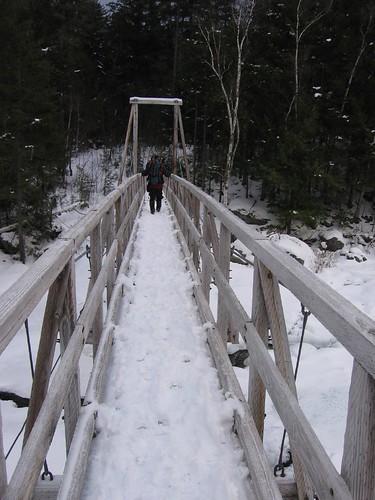
It was a great weekend in New England, especially in New Hampshire, where we took the opportunity to get in one last winter hike for the season - before the warmer weather turns the remaining snow to slush.
Mount Washington, home to wind speeds of up to 231mph - the highest recorded anywhere on earth – beckoned.
The Tuckerman Ravine and Lion’s Head trail rises 4256 feet to 6288 feet over a distance of 5 miles, with the last 1200 feet, a rocky, icy climb, in a little over 1 mile.
Out and back, carrying about 25lbs of winter gear and wearing 4.5lbs of mountaineering boots and crampons on each foot, took a little over 8 hours. Once again, the Lion’s Head winter route provided plenty of technical challenge, overcome by toe-pointing and a deftly swung ice ax.
Wind speeds at the summit were light at 33mph, with gusts up to 56mph and temperatures a balmy 22F.
A 32-mile drive along the Kangamangus Highway (a misnamed narrow twisty two-way road) and we were at the Franconia Ridge side of the White Mountains and set up after eight hours sleep (on the floor of our host’s cabin) for day 2 – a 12 miles round trip hike up Mount Garfield.
Garfield’s grade is less aggressive than Washington, with a summit at 4500 feet, rising from 1400 feet at the road and requires a one-mile walk-in along a forest road before the trail begins.
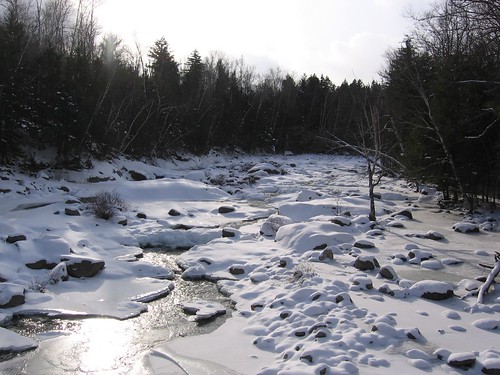
Five miles later, after a couple of rock-hopping stream crossings, tangling with the close-packed tops of fir trees poking through the snow and post-holing (sinking up to the thigh in softening snow) more than 20 times, the summit and its old fire tower base offers spectacular views.

Mount Washington photos:


Mount Garfield photos:


Roll on spring and the mud season - because then it's summer.

Monday, March 31, 2008

A weekend of two halves

We spent all day Saturday doing our civic duty, voting to spend taxpayers money at the Lincoln Town Meeting. And yes, I did stand up twice to ask questions and make a point, although I left the hat at home.

Highlight was the adoption of a warrant article to reduce the use of fossil based fuels in new construction and major renovation of town owned buildings (including residential) by 50 percent by next year (2008) and to eliminate its use completely by 2030 - a very aggressive schedule. The town is following the lead of the Architecture Challenge 2030 initiative.

The warrant is particularly relevant given the Lincoln Public Schools K-8 identified the need to spend between $33 million and $65 million on rehabilitation or rebuilding over the next 10 years and the town's green environment committee identifies these public building as the least energy efficient in the town.

It was also good news for people who like to speed through Lincoln as they make a rat run around 128 bottlenecks in their dash to Routes 2 and 2A. The town voted to spend $5.5 million dollars over three years fixing its notorious - some would say quintessentially Lincolnesque - potholes.
Sorry everyone, the work will not start until after next winter's pothole season.

So if Saturday involved sitting in the dimly lit Brooks Auditorium for a little over nine hours, albeit for me for the first time in the "comfy seats" rather than steel chairs set out for non-voters, then Middlesex Fells once again provided an antidote of blue sky, bright sunshine and croaking of tree frogs in place of, at times, the long winded carping of residents.

We met up with AMC friends for a more leisurely walk of the Skyline Trail which afford the opportunity to spot and handle a garter snake, listen to freshly minted tree frogs and see numerous birds, including red tailed hawks and a great blue heron swooping overhead.

Sadly the Osprey Aether backpack was missing from this trip. It's on back-order - one of the many other signs of spring.

Sunday, March 23, 2008

Middlesex Fells a revelation of a reservation


OK, so no snow, elevation, mountain vistas or cold weather, but Middlesex Fells, only 20 minutes from home (excluding the time taken to find a parking spot among the dog brigade) is nothing short of delightful and proved a great place to try out my new Asolo Fugitive GTX boots.

The 7-mile long Skyline trail, cunningly marked with white blazes to simulate the Appalachian Trail, criss-crosses the parks other trails to such an extent that it is more a test of observation than stamina. Its craggy terrain, mix of mud and occasional steep section were a vast improvement on the silly-sloped test bed found in most outdoor stores. Pity it left its mark on the sole - guess I'll be keeping these boots, despite the relaxed fit.
Covering the 7 miles in a little under 3 hours under light to no-load conditions sets a useful benchmark for measuring fitness conditioning as we count down to the big trip.

Next up it will provide the perfect place to try out my new Osprey Aether pack, the one I currently covet for our Alaska back country trip. That is when I buy it.

Tuesday, March 11, 2008

Another weekend of magic in the snow


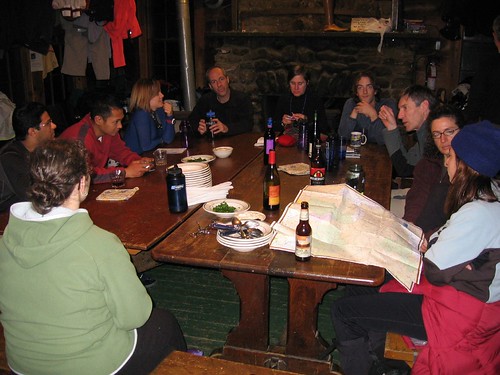
We got to play in the snow again as part of the above treeline workshop run by the Boston Chapter of the Appalachian Mountain Club. Thanks to Larry, Reji and Bob for all their sound advice and encouragement.

Check out the self-arrest practice.


Lot of fun.

More pictures: Harvard Cabin Above Treeline

Sunday, February 17, 2008

Cardigan Lodge High Cabin

The high cabin is situated about 2 miles and 1200 feet above the much cozier Cardigan Lodge. Only two hours from Boston and with some brutal above tree line weather, great snowshoe trails makes this a great getaway destination.
We had an interesting weekend, as much for the personalities, as for the hiking activities which felt curtailed by some participants lacking the correct gear required for the trip above tree line.
Still, as this was billed as a workshop, much learning took place.
For example, carry firewood to replenish cabin supplies, even if only three logs, makes for a long slow climb. Oh, and there's only so much food (which I have to say was all very filling and tasty) that seven people can eat and carrying it both ways feels, well, excessive.

I used my Osprey Atmos 65 pack for the first time. I just love its suspension system, easy access and abundance of useful features all in a 3lb 12oz package for the tall version.

Sideshow

Monday, January 07, 2008

Crawford Notch Weekend - winter hiking


  • The Shapleigh Studio Bunkhouse is much warmer than Harvard Hut. A delight.
  • Arrive early to snag the four-person room (with en-suite toilet and clothes storage). It also has the benefit of not being a thoroughfare, unlike the 12-person bunkhouse.
  • If you snag the four person room, try not to look too smug all weekend as you pass through the masses to your domain.
  • Having a bottom bunks make organizing gear easier than doing so on the top bunk, so be aware of the difficulties someone 'up top' may be having.
  • When lights go out people are respectful of each other's need to sleep. Snoring was not a problem (at least not for me).
  • Make sure lights go out at reasonable time (like 10 p.m.) and if two people want to carry on discussing gear until 11:15 p.m. (even if they're leaders) ask that they do so outside of the sleeping area in the communal space.
  • Food is plentiful and filling, if a little overcooked (and kept warm too long).
  • Add a fruit teabag to hot water in your Nalgene bottle to provide a hot/warm interesting drink for the hike.
  • Packets of honey make a useful quick energy boost squeezed from packet or dissolved in water.
  • The Highland Center is not particularly conducive to group bonding. There are too many alternative places to go – like film shows, ping-pong, the fireside or bunkhouse.
  • After a 9.2 mile hike lasting from 8a.m.until 4:30 p.m. and an elevation gain of 2700 feet, the bunkhouse is too tempting an option.
  • If you take a bigger pack then you will tend to overload it with unnecessary gear.
  • The weekend pace seems non-stop. Breakfast at 6:30 a.m.; pack gear and convene at 7:30 a.m.; depart for hike at 8:00 a.m.; hike until darkness; shower/change and happy hour; dinner at 6:00 p.m. and then other activities or exhaustion.
  • Repeat first three next day.
  • The hiking pace is steady but constant, with the longest stop being one of 15 minutes with multiple stops for water, snack and layer changes of one, two or three minutes.
  • Calling out length duration of stops e.g. one minute water break, two minute layer strip, three minutes to eat, drink and adjust gear etc. works really well in keeping the group organized and moving (thanks Larry).
  • Anyone cna and should call a stop when they need too.
  • After a long hike it's worth knowing that the shower nearest to the kitchen area runs cold or lukewarm at best. It has a long-term valve problem according to the caretaker.
  • Towels are provided, so you don't have t pack one.
  • Trip leaders are knowledgeable and communicate well to a mixed cross-section of ages, fitness and experience. They don't always have to be in front and will let you take your turn route finding and trail breaking.
  • There is a wide range of fitness levels, some people overestimate theirs and can usually be seen carry an over sized pack.
  • Group dynamics were excellent for most of the weekend - AMC people are amazing, but...
  • If people are silent while hiking, it does not mean they are unfriendly – just enjoying the peacefulness.
  • Some people like to talk about themselves too much, which is OK the first time you hear it, but when the same information is conveyed loudly to multiple people in the same hiking party, it becomes.. well, boring. It invades the quietness of winter, snow falling from trees, the swish-glop sound of snowshoes on powder and water running under thin ice.
  • Quiet two person conversations are OK (but difficult when hiking in a line with adequate 'slip and slide space' between hikers.
  • You can be too hot in air temperatures of 34F in a couple of thin base layers when hiking up hill in calm weather. Same applies when it's 10 or 20F
  • Carry fewer layers – and ideally use a multipurpose soft shell with 'windstopper' water repellent fabric.
  • Re-tie boots tighter at the ankle for descents – to pull foot further back
  • Leave boots tied loosely at ankle for ascents to allow for inclination angle and prevent shin bang damage.
  • The winter views are simple amazing.
More Photos:
Mount Pierce and Mount Eisenhower
Mount Jackson
Mount Avalaon

Sunday, December 09, 2007

Saturday, December 08, 2007

I now know that...

Things I learned or would like others to learn.
  • If you leave your gear downstairs and go to bed, people arriving later will simply move it out of the way to some random place. Don’t assume others will not touch or move your gear.
  • Mark all gear. That includes boots and snowshoes. Asking if someone has your boot liners or trying to get feet into the size 10 plastic shells of someone else instead of your 11’s, well simply wont work.
  • Bring your stuff in stuff sacks and keep them together in another bag.
  • A bigger backpack than is needed is better than a backpack that is too small. Err on the large size.
  • Some people I have an incredibly loud snore that only they can sleep through. Yes, the trip leaders warned me and I had ear plugs, but for some unknown reason I still did not use them.
  • Some people have never tried or used their equipment before. This is understandable early in the winter hiking season or with rental equipment. If you’re in this position, how about spending an hour alone with that new gear, adjusting it, walking about outside in those rental boots instead of waiting until everyone is dressing or dressed to leave for the hike?
  • People with new gear to put on or use should not ‘volunteer’ to do breakfast clear up.
  • Your level of fitness is a perception before a hike and a reality during it. Make sure your perception matches reality by testing yourself honestly before demonstrating its lack in front of your fellow hikers.
  • Even in rustic surroundings social graces count for a lot. So put the lid down in the composting outhouse, wash your hands or use sanitizer and sneeze into the crook of your elbow not on my plate.
  • Watch out for people near your car with snowshoes strapped to their packs. They have no idea how large they are.
  • Snowshoes can accidentally scratch down to bear metal on your car in 0.2 seconds.
  • Don’t put backpacks with snowshoes attached into the passenger compartment of your car, if you value your paintwork.
  • Don’t value your paintwork, or carpets.
  • Hot water in a Nalgene bottle inside your sleeping bag is heaven.
  • Put the Nalgene in an old sock or else it will burn you.
  • Bringing one bottle of wine is not enough – unless of course everyone brings one.
  • Wear waterproof shells or pants that shed snow. Even when cold, snow melts when it comes into contact and soaks through.
  • The same goes for hands. They may be warm enough not to wear gloves or shells, but only until you slip and put one or both hands into a snow drift.
  • Don’t expect to hike fast. A lot of time will be spent adjusting gear by people who have not used it before. The same people are likely to have minor problems like shin bang, blisters or other gear problems and general discomfort.
  • People like to define themselves and you by the job they do or by where you work. It’s a reasonable conversation starter, but not the best. Try to find a new approach, unless you’re the President (of the USA).
  • Listening is as valuable as talking.
  • Stopping or turning to talk on the trail is not good for the five or six people walking behind you.
  • If a stop is called by the leader for 2 or 10 minutes the keep it to 2 or 10 minutes. Avoid roll on. For example hiker ‘A’ stops for a layer adjustment, ‘B’ adjust layers and goes for a pee, ‘C’ adjust layers and has a drink and eats some food whilst ‘B’ pees and then decides – heh, I need a pee too. ‘D’, ‘E’ and ‘F’ stripped off ready to go in 2 minutes and stand around for 10 minutes getting cold. Empathy and awareness please people.
  • Smile – this is fun, this is the outdoors, this is winter hiking in groups.

Friday, December 07, 2007

Winter wonder land

That extreme cold numbs the brain and slows down response time was not an excuse we could use. Well, not yet. Especially after a comfortable and cozy drive to New Hampshire and Harvard Cabin for the winter hiking program “debug the gear”, weekend in December.
The propane tank is leaking. The propane tank is empty. The circuit breaker is sticking or not sticking. For more than 30 minutes - as one of the early arrivals at Harvard Cabin on a Friday evening in December when the external thermometer read 19F and the one inside the cabin read 10F – five others and I attempted to master lighting the massive heater.
The fact that the cooker in the kitchen wouldn’t light either re-enforced the no gas theory and brought fresh concerns. Yes, we could layer up, keep moving or simply go to bed in zero degree bags we were instructed to bring. Mine was only rated to 15F, but that wasn’t the problem on my mind. Cooking food and melting snow for water, now that was a problem, although we wouldn’t starve – not with a brewpub 10 minutes down the road.
The heater instructions were long, but straightforward. All except the initial one that told of operating a switch above the breaker box. Now my definition of a breaker box is also straightforward. It is a box with breakers inside. There was no switch above it and so no switch was switched, making the execution of the next seven or eight steps meaningless.
Folks, the switch is IN the breaker box – above a bank of breakers. It is in itself a breaker and looks like the master switch of a normal breaker box.
I can’t remember who made the discovery, but I know I went to the cooker one more time, turned the knob, smelled gas and lit it. I went through similar steps with the heater and we were all set for the weekend.

Wednesday, November 14, 2007

Winter perils in the making.

Tripping up the steps of 5 Joy Street, headquarters of the Appalachian Mountain Club was not the ideal way to begin a five-week training program on Winter Hiking.

Maybe it was the strain of ambling up Beacon Hill from Boston Common, but that’s what I did.

Fortunately, two pairs of hands instinctively reached out from the top of the steps and I found myself pulled to safety from the top and pushed to safety from the bottom by my wife, who stood a step or two below me. The hands from above belonged to two of the course instructors, who later also introduced themselves as trip leaders for our winter hikes. I wondered as I brushed off my embarrassment if this wasn’t just the first of many times when helping hands would be required.

The Hiking and Backpacking Committee, H&B for short, of the Boston Chapter of the AMC runs this course annually, or has for the past six years. During this time they have developed a half-inch thick tome of knowledge, artfully titled ‘An Introduction to Winter Hiking’ - just in case the uninitiated thought that this was all there was to it.

Checking-in I collected my nametag and found myself a minor celebrity. Not only was my badge number 1, which meant I was the first to register and pay for the course, but I also shared the same family name with two of the instructors. We are not related, at least as far as I know, but within a few minutes of the start of the formal part of the evening, it felt as if I had joined a rather large family of similarly minded people.

Formal is too strong a word for events as they unfolded. It’s hard to be formal when someone stands barefooted in front of an audience in his underwear and explains the theory of heat management – which can be over-simplified as layers good, perspiration and cotton clothing bad. Not just bad, but very bad, bad to the point of forbidden.

The same goes for anything other than two-layer footwear; the sort that has removable liners is the only type of footwear allowed on AMC led winter hikes. Hard plastic mountaineering boots (similar to their downhill ski cousins) seemed to be the boot of choice for the majority of leaders in attendance, although at least one person favored the old stand-by Sorrel boot.

I don’t want to give the impression that these hardened devotees of winter solitude came dressed in expensive duds, although one person did sport a Arc’teryx® backpack that I know comes with a $549 price tag. Pants, stuff sacks and backpacks sported their fair share of duct tape patches, a simple remedy I suspect for a brush with unguarded crampons and ice axes or unavoidable tree limbs.

Perhaps the main advantage of attending the course, which works out at a meager $9 per week - apart from the obvious one of limiting the chances of ending up as a statistic in the New Hampshire Fish and Game annals of bad things that happen to others – is the opportunity to sign-up for those illusive winter trips I said I would do last year.

These are the ones I read about in AMC Outdoors or the Charles River Mud newsletter a week before they happen, or more usually a week or two afterwards.

Imagine that. Planning your winter hikes, secure in the knowledge that your destination hut or lodge is not booked up, that you will be in the company of like-minded or at least as insane people and led by an experienced hiker who has not only lived to tell the tale, but is willing to share the experience with a novice.

Roll on winter – at least until next week's session