Showing posts with label travel. Show all posts

Thursday, December 03, 2009

Leaving home

Early morning is not my favorite time of day, especially when it means a trip to Logan for the first flight out of the day.
A week ago was different.
From home - 13 miles northwest of Boston - to departure lounge in a little over 90 minutes thanks to a lift to Alewife 'T' Station and then a $1.75 ride to Terminal B. True, a limo takes half the time, but at a cost of $85. Automatic check-in, quick baggage handling, even quicker security check - does it get any better?
Well yes, because after grabbing a Starbucks coffee and rounding the corner to the departure gate, this is the sight that met my gaze. OK, the sun was a little higher than first viewing by the time I grabbed my camera, found a spot to minimize through-glass reflections. You could call it a glowing send off.

Wednesday, June 04, 2008

Heads up

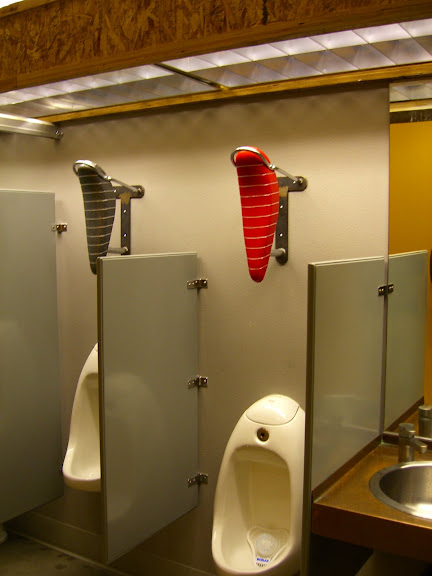
It's better to seek forgiveness than ask for permission. So with your forgiveness I couldn't resist snapping this restroom shot taken at the Hopworks Urban Brewery in the SE Portland district.

The brewpub beers are excellent and food well above what is normally described as pub grub.

Men will require no explanation for the bike saddles strategically located above the urinals.

Let's just say men adopt many different styles when doing what comes naturally and those styles are often directly influenced by the amount and strength of alcohol consumed.

So when the time comes and head heaviness is impossible to deny, how much easier on the forehead is a soft saddle than the stone wall normally provided.

Keen observers will note that, rightly so, headrests are not provided for children using the lower of the two urinals.

Monday, June 02, 2008

#42 - A Chinese garden

The problem with visiting a Chinese garden is that as soon as you leave you want to visit another one. OK, it's a poor joke - but a good garden.
Located in Portland's downtown Chinatown and tucked away behind grey painted stone walls, the Portland Classical Chinese Garden is less extensive, but as expensive to visit as the more distant Japanese gardens. Rocks, water and buildings feature more profusely than flowering plants, giving a harsh defined edge to most vistas.

Sunday, June 01, 2008

Japanese Garden, Portland

It is difficult to capture the shear beauty of this gardens either in words or pictures. Manicured is too clinical a word, perhaps ordered is better.

Each garden, a delight in itself, leads to another, blending stone, bamboo, sculptures and plants into organic shades and shapes.

Even in drizzly overcast weather, a fact of life in Portland as it is in England where it creates a similar green lushness of moss and foliage, the garden is serene and welcoming.

Saturday, May 31, 2008

The price of a thirty-second thrill

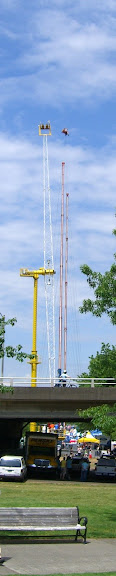
Seven small steps lead to a painted platform, where, locked into place, rests what looks like a special love seat – with seat belts and shoulder harness.

At either side of the seat, two pairs of steel cables stretch tight as they soar up more than 150 feet into the air, disappearing at the top of flimsy steel towers, themselves guy roped back down to the platform's steel structure.

At the top of the steps, small wicker baskets provide a safe repository for pocketbooks, coins and keys – or anything else likely to fly loose in the brief vertical flight skyward.

A chubby raven haired woman tucks her flowing skirt under her legs, as if that will be enough to spare her modesty as she catapults from the ground, accelerating to 60 mph in under two seconds.

The scraggy bearded man next to her is all bravado, waving to friends on the ground in an exaggerated two-fisted pump. The sound of a motor whines into life and bank of 3-inch diameter coiled steel springs arranged in a 20 x 20 matrix begin to elongate under the determined influence of a hydraulic shaft, its surface glistening with fluid in the high noon sun.

For a fraction of a second there is silence following the clunk of the safety catch release. A scream rises in pitch as the love seat soars high into the air, tops out above the pylons, inverts, and the couple begins their face-down freefall accelerating at 32 feet per second, for each second they plummet towards the ground and certain oblivion.

Two-thirds of the way down to eternity, the steel cable pulls tight arresting the descent before firing the now silent duo back up to the top of the tower. The sinusoidal decay continues for a few more seconds, before the mechanism lowers them to ground where released from their restraints, they stumble towards the same steps previously trod with great gusto.

Muted victory salutes acknowledge reminders to retrieve their valuables from the baskets.

This is Portland, Oregon waterfront on Rose Festival week where such thrills come at the high price of $50 for a thirty-second ride to the sky.

The answer to your question is no, no way.


Wednesday, May 07, 2008

Storm Over Everest

I sat in the audience of filmmakers, producers, mountaineers and 60 or so other people who had applied to attend a preview of Frontline's 'Storm Over Everest' in WGBH's plush Brighton studio auditorium.
Prayer flags strung along the sidewalls fluttered in the air conditioning.
Climber, producer, director, David Breashears waited 10 years, almost to the day, to release a film the events of 1996, when 11 died on Everest in what has been variously described as a freak storm and a failure of leadership.
I have read several accounts by those involved, Jon Krakauer, Anatoli Boukreev, Doug Hansen, to name three. Each differs in there account, unsurprising given that most of what happened occurred above 26,000 feet, where, put quite simply, the brain fails to function.
Breashears' film does not solve any of the many riddles, not does it provide much fresh information. What is does do beautifully, using a mix of simulation and first hand accounts, is to put the events in the context of the appalling conditions in which some died, some lived, some were heroes and others were found wanting.
A nervous Breashears, who was on Everest with his IMAX film team and took part in the many rescue attempts, introduced his work and he answered only a few questions after the preview.
In fact Breashears seemed as concerned that is two godchildren approved of his efforts as he did the audience. At least they gave him a thumbs up afterwards.
None of the Storm Over Everest film footage came from Breashears 1996 filming activity and is a recreation of conditions. This does not detract from the film's emotional poignancy, exemplified by the audience silence during rolling of the credits, before breaking out into a mix of applause that ranged from polite to enthusiastic.
The film will be aired on PBS on Tuesday May 13 and online until June 16.
I recommend putting on a down jacket, turning the air conditioning to minimum, yanking up the audio system volume and trying to imagine what it was like to be trapped in the death zone. Just don't try and figure out why – it's what people do.

Monday, January 07, 2008

Crawford Notch Weekend - winter hiking


  • The Shapleigh Studio Bunkhouse is much warmer than Harvard Hut. A delight.
  • Arrive early to snag the four-person room (with en-suite toilet and clothes storage). It also has the benefit of not being a thoroughfare, unlike the 12-person bunkhouse.
  • If you snag the four person room, try not to look too smug all weekend as you pass through the masses to your domain.
  • Having a bottom bunks make organizing gear easier than doing so on the top bunk, so be aware of the difficulties someone 'up top' may be having.
  • When lights go out people are respectful of each other's need to sleep. Snoring was not a problem (at least not for me).
  • Make sure lights go out at reasonable time (like 10 p.m.) and if two people want to carry on discussing gear until 11:15 p.m. (even if they're leaders) ask that they do so outside of the sleeping area in the communal space.
  • Food is plentiful and filling, if a little overcooked (and kept warm too long).
  • Add a fruit teabag to hot water in your Nalgene bottle to provide a hot/warm interesting drink for the hike.
  • Packets of honey make a useful quick energy boost squeezed from packet or dissolved in water.
  • The Highland Center is not particularly conducive to group bonding. There are too many alternative places to go – like film shows, ping-pong, the fireside or bunkhouse.
  • After a 9.2 mile hike lasting from 8a.m.until 4:30 p.m. and an elevation gain of 2700 feet, the bunkhouse is too tempting an option.
  • If you take a bigger pack then you will tend to overload it with unnecessary gear.
  • The weekend pace seems non-stop. Breakfast at 6:30 a.m.; pack gear and convene at 7:30 a.m.; depart for hike at 8:00 a.m.; hike until darkness; shower/change and happy hour; dinner at 6:00 p.m. and then other activities or exhaustion.
  • Repeat first three next day.
  • The hiking pace is steady but constant, with the longest stop being one of 15 minutes with multiple stops for water, snack and layer changes of one, two or three minutes.
  • Calling out length duration of stops e.g. one minute water break, two minute layer strip, three minutes to eat, drink and adjust gear etc. works really well in keeping the group organized and moving (thanks Larry).
  • Anyone cna and should call a stop when they need too.
  • After a long hike it's worth knowing that the shower nearest to the kitchen area runs cold or lukewarm at best. It has a long-term valve problem according to the caretaker.
  • Towels are provided, so you don't have t pack one.
  • Trip leaders are knowledgeable and communicate well to a mixed cross-section of ages, fitness and experience. They don't always have to be in front and will let you take your turn route finding and trail breaking.
  • There is a wide range of fitness levels, some people overestimate theirs and can usually be seen carry an over sized pack.
  • Group dynamics were excellent for most of the weekend - AMC people are amazing, but...
  • If people are silent while hiking, it does not mean they are unfriendly – just enjoying the peacefulness.
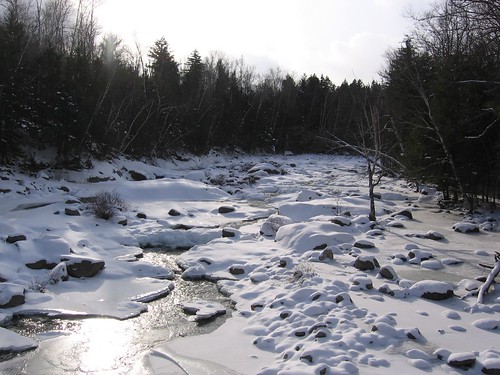
  • Some people like to talk about themselves too much, which is OK the first time you hear it, but when the same information is conveyed loudly to multiple people in the same hiking party, it becomes.. well, boring. It invades the quietness of winter, snow falling from trees, the swish-glop sound of snowshoes on powder and water running under thin ice.
  • Quiet two person conversations are OK (but difficult when hiking in a line with adequate 'slip and slide space' between hikers.
  • You can be too hot in air temperatures of 34F in a couple of thin base layers when hiking up hill in calm weather. Same applies when it's 10 or 20F
  • Carry fewer layers – and ideally use a multipurpose soft shell with 'windstopper' water repellent fabric.
  • Re-tie boots tighter at the ankle for descents – to pull foot further back
  • Leave boots tied loosely at ankle for ascents to allow for inclination angle and prevent shin bang damage.
  • The winter views are simple amazing.
More Photos:
Mount Pierce and Mount Eisenhower
Mount Jackson
Mount Avalaon

Friday, December 07, 2007

Winter wonder land

That extreme cold numbs the brain and slows down response time was not an excuse we could use. Well, not yet. Especially after a comfortable and cozy drive to New Hampshire and Harvard Cabin for the winter hiking program “debug the gear”, weekend in December.
The propane tank is leaking. The propane tank is empty. The circuit breaker is sticking or not sticking. For more than 30 minutes - as one of the early arrivals at Harvard Cabin on a Friday evening in December when the external thermometer read 19F and the one inside the cabin read 10F – five others and I attempted to master lighting the massive heater.
The fact that the cooker in the kitchen wouldn’t light either re-enforced the no gas theory and brought fresh concerns. Yes, we could layer up, keep moving or simply go to bed in zero degree bags we were instructed to bring. Mine was only rated to 15F, but that wasn’t the problem on my mind. Cooking food and melting snow for water, now that was a problem, although we wouldn’t starve – not with a brewpub 10 minutes down the road.
The heater instructions were long, but straightforward. All except the initial one that told of operating a switch above the breaker box. Now my definition of a breaker box is also straightforward. It is a box with breakers inside. There was no switch above it and so no switch was switched, making the execution of the next seven or eight steps meaningless.
Folks, the switch is IN the breaker box – above a bank of breakers. It is in itself a breaker and looks like the master switch of a normal breaker box.
I can’t remember who made the discovery, but I know I went to the cooker one more time, turned the knob, smelled gas and lit it. I went through similar steps with the heater and we were all set for the weekend.

Wednesday, November 14, 2007

Winter perils in the making.

Tripping up the steps of 5 Joy Street, headquarters of the Appalachian Mountain Club was not the ideal way to begin a five-week training program on Winter Hiking.

Maybe it was the strain of ambling up Beacon Hill from Boston Common, but that’s what I did.

Fortunately, two pairs of hands instinctively reached out from the top of the steps and I found myself pulled to safety from the top and pushed to safety from the bottom by my wife, who stood a step or two below me. The hands from above belonged to two of the course instructors, who later also introduced themselves as trip leaders for our winter hikes. I wondered as I brushed off my embarrassment if this wasn’t just the first of many times when helping hands would be required.

The Hiking and Backpacking Committee, H&B for short, of the Boston Chapter of the AMC runs this course annually, or has for the past six years. During this time they have developed a half-inch thick tome of knowledge, artfully titled ‘An Introduction to Winter Hiking’ - just in case the uninitiated thought that this was all there was to it.

Checking-in I collected my nametag and found myself a minor celebrity. Not only was my badge number 1, which meant I was the first to register and pay for the course, but I also shared the same family name with two of the instructors. We are not related, at least as far as I know, but within a few minutes of the start of the formal part of the evening, it felt as if I had joined a rather large family of similarly minded people.

Formal is too strong a word for events as they unfolded. It’s hard to be formal when someone stands barefooted in front of an audience in his underwear and explains the theory of heat management – which can be over-simplified as layers good, perspiration and cotton clothing bad. Not just bad, but very bad, bad to the point of forbidden.

The same goes for anything other than two-layer footwear; the sort that has removable liners is the only type of footwear allowed on AMC led winter hikes. Hard plastic mountaineering boots (similar to their downhill ski cousins) seemed to be the boot of choice for the majority of leaders in attendance, although at least one person favored the old stand-by Sorrel boot.

I don’t want to give the impression that these hardened devotees of winter solitude came dressed in expensive duds, although one person did sport a Arc’teryx® backpack that I know comes with a $549 price tag. Pants, stuff sacks and backpacks sported their fair share of duct tape patches, a simple remedy I suspect for a brush with unguarded crampons and ice axes or unavoidable tree limbs.

Perhaps the main advantage of attending the course, which works out at a meager $9 per week - apart from the obvious one of limiting the chances of ending up as a statistic in the New Hampshire Fish and Game annals of bad things that happen to others – is the opportunity to sign-up for those illusive winter trips I said I would do last year.

These are the ones I read about in AMC Outdoors or the Charles River Mud newsletter a week before they happen, or more usually a week or two afterwards.

Imagine that. Planning your winter hikes, secure in the knowledge that your destination hut or lodge is not booked up, that you will be in the company of like-minded or at least as insane people and led by an experienced hiker who has not only lived to tell the tale, but is willing to share the experience with a novice.

Roll on winter – at least until next week's session

Friday, November 02, 2007

Ottawa daze

So with the parade over it was time to be 'Not An Englishman in Boston' but a 'AEIO'. That's right – an Englishman in Ottawa – at least for a few days.

Ottawa is a city that just draws me in with its museums, galleries, the Ottawa River, Rideau Canal, Gothic buildings and a regular schedule of events that range from jazz and blues festivals to the Wine and Food show.

The latter provided the impetus for a five-day break. That and expiring Air Canada miles and an overdue opportunity to catch up with good friends made before and during our time living there from 1998 to 2000.

Of course, I noticed the flailing US dollar purchased less and the unmistakable look of satisfaction on d' Canadians' friendly faces as we talked about where it had all gone wrong (or right depending on which side of the border you hang your woolly hat).

I spent almost an entire day in the newly minted Canadian War Museum – where amongst other things I learned with satisfaction that people from 1766 called patriots in the US are described less politely as 'The American Rebels' in Canada.

Indeed much of the early infrastructure, at least after General Wolf defeated a somewhat overzealous Montcalm to win Canada from the French, was established to defend a Canada loyal to the English crown from American infiltration.

Still the wine and food show presented a great opportunity to drink to the Americas and bring into the fold a few Commonwealth countries such as Australia and New Zealand aswell as some EU partners such as France and Germany. Curiously, save the smallest table imaginable, Italy was absent from the party.

The National Gallery of Canada, fresh with a photo exhibit 'Snap Judgment' featuring the brighter side of life in the continent of Africa (at least for the most part) presented an opportunity to replace the all pervasive images of disease, famine, warlords and genocide that are the 'photostock' trade of journalists and image makers. In addition, all of the images came from talented and in many cases self-taught, up-and-coming African photographers.

My own images of Ottawa can be found on Flickr at by clicking here.

I spent a wonderful afternoon on Halloween in the Earl of Sussex Pub, just people watching/listening. Everything changes, the whole dynamics of personal interaction, when at least one of the people is hiding behind a costume mask. Sadly, I was not one of them and could only marvel at the bravery of some souls.

Wednesday, October 24, 2007

More required than a passenger bill of rights

Boston City Councilors are seeking to create a taxi passenger bill of rights along the lines of providing a safe, functioning and clean cab, with no music playing in the cab or cabbies chatting on cell phones while driving. In their response, according to an article in the Globe, cab drivers want a bill of rights for themselves; no drunk and vomiting passengers, no more than four passengers per cab ride and no abuse of the driver by passengers.

What I want is to pay via a fairs fare system, not take my life in my hands when I (rarely) take a cab and a driver who knows where he or (rarely) she is going.

I can say in all honesty, that I have never ever had a good or even satisfactory cab ride in Boston. Compared to the black cabs in London or even the yellow cabs in New York, Boston’s thinly disguised white coated cabs and their drivers are more like opportunists in clapped-out, cast-off cruisers. That seems to go for the suburbs too, based on my recent experience.

Journeys over 12 miles are charged at a flat, non-metered rate. A cab from Logan Airport to a town like Lincoln, 18.4 miles away, costs a flat rate $46.80, plus an airport charge of $2.25, plus tunnel tolls of $4.50, say $53.75 in all. Flat rate fares are charged at $2.60 per mile, metered fares are charged at $2.40 per mile plus a starting meter charge of 2.25. Either way the base fare, excluding tolls and airport fees, is between $46 and $47.

When I took a cab from Alewife T station to Lincoln--a distance of 9.6 miles--I assumed the same rules would apply. Not so – at least according to the driver and the dispatcher he had me talk to on his cell phone.

I should have been clued in by the fact the driver disappeared for a few minutes when we got in his sweltering cab and left us sitting there while he talked to the driver behind him. I should have known when he did not start the meter that we were in for a flat rate and as it turned out a flat out ride.

We had been traveling from Ireland to Boston via Dublin and Heathrow, including layovers, for the better part of 18 hours and were understandably tired. We took the Silver Line to South Station and then the Red Line to Alewife Station. The cost for the 40-minute subway-ride was $1.75 and it was around 9:30pm when we dragged ourselves to the taxi rank.

Then the cab took us for a ride.

Loading our bags ourselves, we found that there was hardly room in the trunk for our two modest size suitcases (they weighed less than 42lbs each – thanks to judicious packing and the weight restrictions imposed on the Heathrow to Dublin leg of the flight).

We could not see out of the cab windows, any of them, because they were so steamed up. More to the point nor could the driver, except through a fuzzy patch the size of a laptop screen.

When we reached the ramp at the Lexington line, we were all plunged into a blackness that the cab’s single working headlight could not penetrate. The driver did not slow down from the maximum permitted speed of 65mph, or perhaps that was just how fast the straining engine could go. The driver’s solution was simplicity itself. He straddled the lane marker, even when three lanes became two and he followed it unerringly, despite the attempts of other vehicles to persuade him to pull over.

In fairness, he did get us home or at least to the top of the drive where he stopped on a our unlit narrow, but busy two-way road, 3 feet from the curb - without hazard indicators flashing.

I waited for the driver to tell me the fare, clutching a twenty and a ten, perhaps more in hope than any real expectation. I was definitely unprepared when he said the fare was $56.

I protested and asked to look at the book of fares. After five minutes of rummaging, he came up empty. I asked for the dispatch telephone number. That’s when I made my second mistake.

He dialed a number and spoke in a language I did not understand and then handed me his phone. I should have dialed the number on my phone.

The dispatcher, or someone who said he was the dispatcher, told me that the fare to Lincoln from Alewife is $56. I paid. It had been a long day.

Did I get the cab drivers name, cab plate, registration or telephone number? No, as I mentioned it had been a long day, now going on 20 hours of travel and foolishly, I was keener to get off the pitch-black road and indoors after 17 days away.

Did I get wise to the cab industry in Boston? Most certainly.

I will never get in cab without checking that its lights work, the driver has a medallion with his picture on it and I know the price he is going to charge.

These are your rights and mine; everything else is just a load of bill.