Showing posts with label winter. Show all posts

Sunday, December 06, 2009

Let it snow

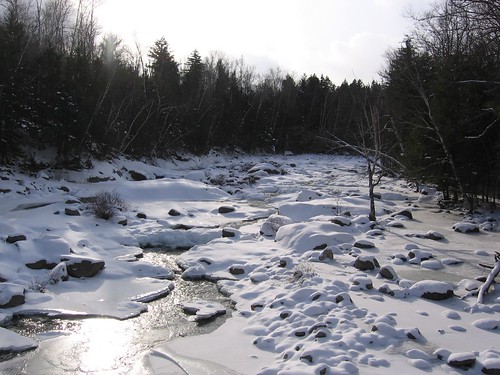
Cool walk in Minuteman National Historic Park after a night of wet and heavy snow. The building is the Hartwell Tavern and dates from the time of the American Revolution. In the summer it is open to the public and features demonstrations of musket firing, weaving and the games people played.
Today there was simply solitude.

Monday, April 07, 2008

'Last Post' for winter hiking


It's over, done with, crampons sharpened and oiled, ice ax hung tenderly in the back hallway and boots dried and, of necessity, airing out as I write.

It was a great weekend in New England, especially in New Hampshire, where we took the opportunity to get in one last winter hike for the season - before the warmer weather turns the remaining snow to slush.
Mount Washington, home to wind speeds of up to 231mph - the highest recorded anywhere on earth – beckoned.
The Tuckerman Ravine and Lion’s Head trail rises 4256 feet to 6288 feet over a distance of 5 miles, with the last 1200 feet, a rocky, icy climb, in a little over 1 mile.
Out and back, carrying about 25lbs of winter gear and wearing 4.5lbs of mountaineering boots and crampons on each foot, took a little over 8 hours. Once again, the Lion’s Head winter route provided plenty of technical challenge, overcome by toe-pointing and a deftly swung ice ax.
Wind speeds at the summit were light at 33mph, with gusts up to 56mph and temperatures a balmy 22F.
A 32-mile drive along the Kangamangus Highway (a misnamed narrow twisty two-way road) and we were at the Franconia Ridge side of the White Mountains and set up after eight hours sleep (on the floor of our host’s cabin) for day 2 – a 12 miles round trip hike up Mount Garfield.
Garfield’s grade is less aggressive than Washington, with a summit at 4500 feet, rising from 1400 feet at the road and requires a one-mile walk-in along a forest road before the trail begins.
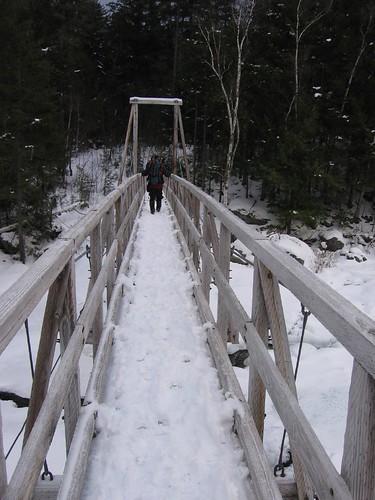
Five miles later, after a couple of rock-hopping stream crossings, tangling with the close-packed tops of fir trees poking through the snow and post-holing (sinking up to the thigh in softening snow) more than 20 times, the summit and its old fire tower base offers spectacular views.

Mount Washington photos:


Mount Garfield photos:


Roll on spring and the mud season - because then it's summer.

Tuesday, March 11, 2008

Another weekend of magic in the snow


We got to play in the snow again as part of the above treeline workshop run by the Boston Chapter of the Appalachian Mountain Club. Thanks to Larry, Reji and Bob for all their sound advice and encouragement.

Check out the self-arrest practice.


Lot of fun.

More pictures: Harvard Cabin Above Treeline

Monday, January 07, 2008

Crawford Notch Weekend - winter hiking


  • The Shapleigh Studio Bunkhouse is much warmer than Harvard Hut. A delight.
  • Arrive early to snag the four-person room (with en-suite toilet and clothes storage). It also has the benefit of not being a thoroughfare, unlike the 12-person bunkhouse.
  • If you snag the four person room, try not to look too smug all weekend as you pass through the masses to your domain.
  • Having a bottom bunks make organizing gear easier than doing so on the top bunk, so be aware of the difficulties someone 'up top' may be having.
  • When lights go out people are respectful of each other's need to sleep. Snoring was not a problem (at least not for me).
  • Make sure lights go out at reasonable time (like 10 p.m.) and if two people want to carry on discussing gear until 11:15 p.m. (even if they're leaders) ask that they do so outside of the sleeping area in the communal space.
  • Food is plentiful and filling, if a little overcooked (and kept warm too long).
  • Add a fruit teabag to hot water in your Nalgene bottle to provide a hot/warm interesting drink for the hike.
  • Packets of honey make a useful quick energy boost squeezed from packet or dissolved in water.
  • The Highland Center is not particularly conducive to group bonding. There are too many alternative places to go – like film shows, ping-pong, the fireside or bunkhouse.
  • After a 9.2 mile hike lasting from 8a.m.until 4:30 p.m. and an elevation gain of 2700 feet, the bunkhouse is too tempting an option.
  • If you take a bigger pack then you will tend to overload it with unnecessary gear.
  • The weekend pace seems non-stop. Breakfast at 6:30 a.m.; pack gear and convene at 7:30 a.m.; depart for hike at 8:00 a.m.; hike until darkness; shower/change and happy hour; dinner at 6:00 p.m. and then other activities or exhaustion.
  • Repeat first three next day.
  • The hiking pace is steady but constant, with the longest stop being one of 15 minutes with multiple stops for water, snack and layer changes of one, two or three minutes.
  • Calling out length duration of stops e.g. one minute water break, two minute layer strip, three minutes to eat, drink and adjust gear etc. works really well in keeping the group organized and moving (thanks Larry).
  • Anyone cna and should call a stop when they need too.
  • After a long hike it's worth knowing that the shower nearest to the kitchen area runs cold or lukewarm at best. It has a long-term valve problem according to the caretaker.
  • Towels are provided, so you don't have t pack one.
  • Trip leaders are knowledgeable and communicate well to a mixed cross-section of ages, fitness and experience. They don't always have to be in front and will let you take your turn route finding and trail breaking.
  • There is a wide range of fitness levels, some people overestimate theirs and can usually be seen carry an over sized pack.
  • Group dynamics were excellent for most of the weekend - AMC people are amazing, but...
  • If people are silent while hiking, it does not mean they are unfriendly – just enjoying the peacefulness.
  • Some people like to talk about themselves too much, which is OK the first time you hear it, but when the same information is conveyed loudly to multiple people in the same hiking party, it becomes.. well, boring. It invades the quietness of winter, snow falling from trees, the swish-glop sound of snowshoes on powder and water running under thin ice.
  • Quiet two person conversations are OK (but difficult when hiking in a line with adequate 'slip and slide space' between hikers.
  • You can be too hot in air temperatures of 34F in a couple of thin base layers when hiking up hill in calm weather. Same applies when it's 10 or 20F
  • Carry fewer layers – and ideally use a multipurpose soft shell with 'windstopper' water repellent fabric.
  • Re-tie boots tighter at the ankle for descents – to pull foot further back
  • Leave boots tied loosely at ankle for ascents to allow for inclination angle and prevent shin bang damage.
  • The winter views are simple amazing.
More Photos:
Mount Pierce and Mount Eisenhower
Mount Jackson
Mount Avalaon

Sunday, December 09, 2007

Saturday, December 08, 2007

I now know that...

Things I learned or would like others to learn.
  • If you leave your gear downstairs and go to bed, people arriving later will simply move it out of the way to some random place. Don’t assume others will not touch or move your gear.
  • Mark all gear. That includes boots and snowshoes. Asking if someone has your boot liners or trying to get feet into the size 10 plastic shells of someone else instead of your 11’s, well simply wont work.
  • Bring your stuff in stuff sacks and keep them together in another bag.
  • A bigger backpack than is needed is better than a backpack that is too small. Err on the large size.
  • Some people I have an incredibly loud snore that only they can sleep through. Yes, the trip leaders warned me and I had ear plugs, but for some unknown reason I still did not use them.
  • Some people have never tried or used their equipment before. This is understandable early in the winter hiking season or with rental equipment. If you’re in this position, how about spending an hour alone with that new gear, adjusting it, walking about outside in those rental boots instead of waiting until everyone is dressing or dressed to leave for the hike?
  • People with new gear to put on or use should not ‘volunteer’ to do breakfast clear up.
  • Your level of fitness is a perception before a hike and a reality during it. Make sure your perception matches reality by testing yourself honestly before demonstrating its lack in front of your fellow hikers.
  • Even in rustic surroundings social graces count for a lot. So put the lid down in the composting outhouse, wash your hands or use sanitizer and sneeze into the crook of your elbow not on my plate.
  • Watch out for people near your car with snowshoes strapped to their packs. They have no idea how large they are.
  • Snowshoes can accidentally scratch down to bear metal on your car in 0.2 seconds.
  • Don’t put backpacks with snowshoes attached into the passenger compartment of your car, if you value your paintwork.
  • Don’t value your paintwork, or carpets.
  • Hot water in a Nalgene bottle inside your sleeping bag is heaven.
  • Put the Nalgene in an old sock or else it will burn you.
  • Bringing one bottle of wine is not enough – unless of course everyone brings one.
  • Wear waterproof shells or pants that shed snow. Even when cold, snow melts when it comes into contact and soaks through.
  • The same goes for hands. They may be warm enough not to wear gloves or shells, but only until you slip and put one or both hands into a snow drift.
  • Don’t expect to hike fast. A lot of time will be spent adjusting gear by people who have not used it before. The same people are likely to have minor problems like shin bang, blisters or other gear problems and general discomfort.
  • People like to define themselves and you by the job they do or by where you work. It’s a reasonable conversation starter, but not the best. Try to find a new approach, unless you’re the President (of the USA).
  • Listening is as valuable as talking.
  • Stopping or turning to talk on the trail is not good for the five or six people walking behind you.
  • If a stop is called by the leader for 2 or 10 minutes the keep it to 2 or 10 minutes. Avoid roll on. For example hiker ‘A’ stops for a layer adjustment, ‘B’ adjust layers and goes for a pee, ‘C’ adjust layers and has a drink and eats some food whilst ‘B’ pees and then decides – heh, I need a pee too. ‘D’, ‘E’ and ‘F’ stripped off ready to go in 2 minutes and stand around for 10 minutes getting cold. Empathy and awareness please people.
  • Smile – this is fun, this is the outdoors, this is winter hiking in groups.

Friday, December 07, 2007

Winter wonder land

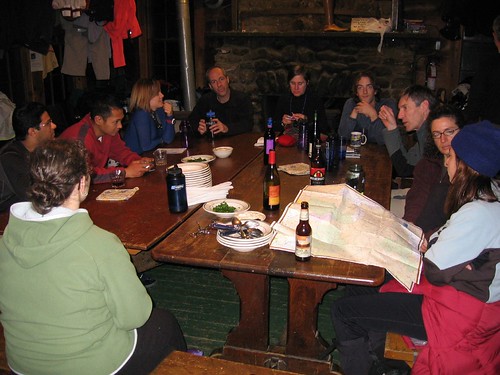
That extreme cold numbs the brain and slows down response time was not an excuse we could use. Well, not yet. Especially after a comfortable and cozy drive to New Hampshire and Harvard Cabin for the winter hiking program “debug the gear”, weekend in December.
The propane tank is leaking. The propane tank is empty. The circuit breaker is sticking or not sticking. For more than 30 minutes - as one of the early arrivals at Harvard Cabin on a Friday evening in December when the external thermometer read 19F and the one inside the cabin read 10F – five others and I attempted to master lighting the massive heater.
The fact that the cooker in the kitchen wouldn’t light either re-enforced the no gas theory and brought fresh concerns. Yes, we could layer up, keep moving or simply go to bed in zero degree bags we were instructed to bring. Mine was only rated to 15F, but that wasn’t the problem on my mind. Cooking food and melting snow for water, now that was a problem, although we wouldn’t starve – not with a brewpub 10 minutes down the road.
The heater instructions were long, but straightforward. All except the initial one that told of operating a switch above the breaker box. Now my definition of a breaker box is also straightforward. It is a box with breakers inside. There was no switch above it and so no switch was switched, making the execution of the next seven or eight steps meaningless.
Folks, the switch is IN the breaker box – above a bank of breakers. It is in itself a breaker and looks like the master switch of a normal breaker box.
I can’t remember who made the discovery, but I know I went to the cooker one more time, turned the knob, smelled gas and lit it. I went through similar steps with the heater and we were all set for the weekend.

Wednesday, November 14, 2007

Winter perils in the making.

Tripping up the steps of 5 Joy Street, headquarters of the Appalachian Mountain Club was not the ideal way to begin a five-week training program on Winter Hiking.

Maybe it was the strain of ambling up Beacon Hill from Boston Common, but that’s what I did.

Fortunately, two pairs of hands instinctively reached out from the top of the steps and I found myself pulled to safety from the top and pushed to safety from the bottom by my wife, who stood a step or two below me. The hands from above belonged to two of the course instructors, who later also introduced themselves as trip leaders for our winter hikes. I wondered as I brushed off my embarrassment if this wasn’t just the first of many times when helping hands would be required.

The Hiking and Backpacking Committee, H&B for short, of the Boston Chapter of the AMC runs this course annually, or has for the past six years. During this time they have developed a half-inch thick tome of knowledge, artfully titled ‘An Introduction to Winter Hiking’ - just in case the uninitiated thought that this was all there was to it.

Checking-in I collected my nametag and found myself a minor celebrity. Not only was my badge number 1, which meant I was the first to register and pay for the course, but I also shared the same family name with two of the instructors. We are not related, at least as far as I know, but within a few minutes of the start of the formal part of the evening, it felt as if I had joined a rather large family of similarly minded people.

Formal is too strong a word for events as they unfolded. It’s hard to be formal when someone stands barefooted in front of an audience in his underwear and explains the theory of heat management – which can be over-simplified as layers good, perspiration and cotton clothing bad. Not just bad, but very bad, bad to the point of forbidden.

The same goes for anything other than two-layer footwear; the sort that has removable liners is the only type of footwear allowed on AMC led winter hikes. Hard plastic mountaineering boots (similar to their downhill ski cousins) seemed to be the boot of choice for the majority of leaders in attendance, although at least one person favored the old stand-by Sorrel boot.

I don’t want to give the impression that these hardened devotees of winter solitude came dressed in expensive duds, although one person did sport a Arc’teryx® backpack that I know comes with a $549 price tag. Pants, stuff sacks and backpacks sported their fair share of duct tape patches, a simple remedy I suspect for a brush with unguarded crampons and ice axes or unavoidable tree limbs.

Perhaps the main advantage of attending the course, which works out at a meager $9 per week - apart from the obvious one of limiting the chances of ending up as a statistic in the New Hampshire Fish and Game annals of bad things that happen to others – is the opportunity to sign-up for those illusive winter trips I said I would do last year.

These are the ones I read about in AMC Outdoors or the Charles River Mud newsletter a week before they happen, or more usually a week or two afterwards.

Imagine that. Planning your winter hikes, secure in the knowledge that your destination hut or lodge is not booked up, that you will be in the company of like-minded or at least as insane people and led by an experienced hiker who has not only lived to tell the tale, but is willing to share the experience with a novice.

Roll on winter – at least until next week's session